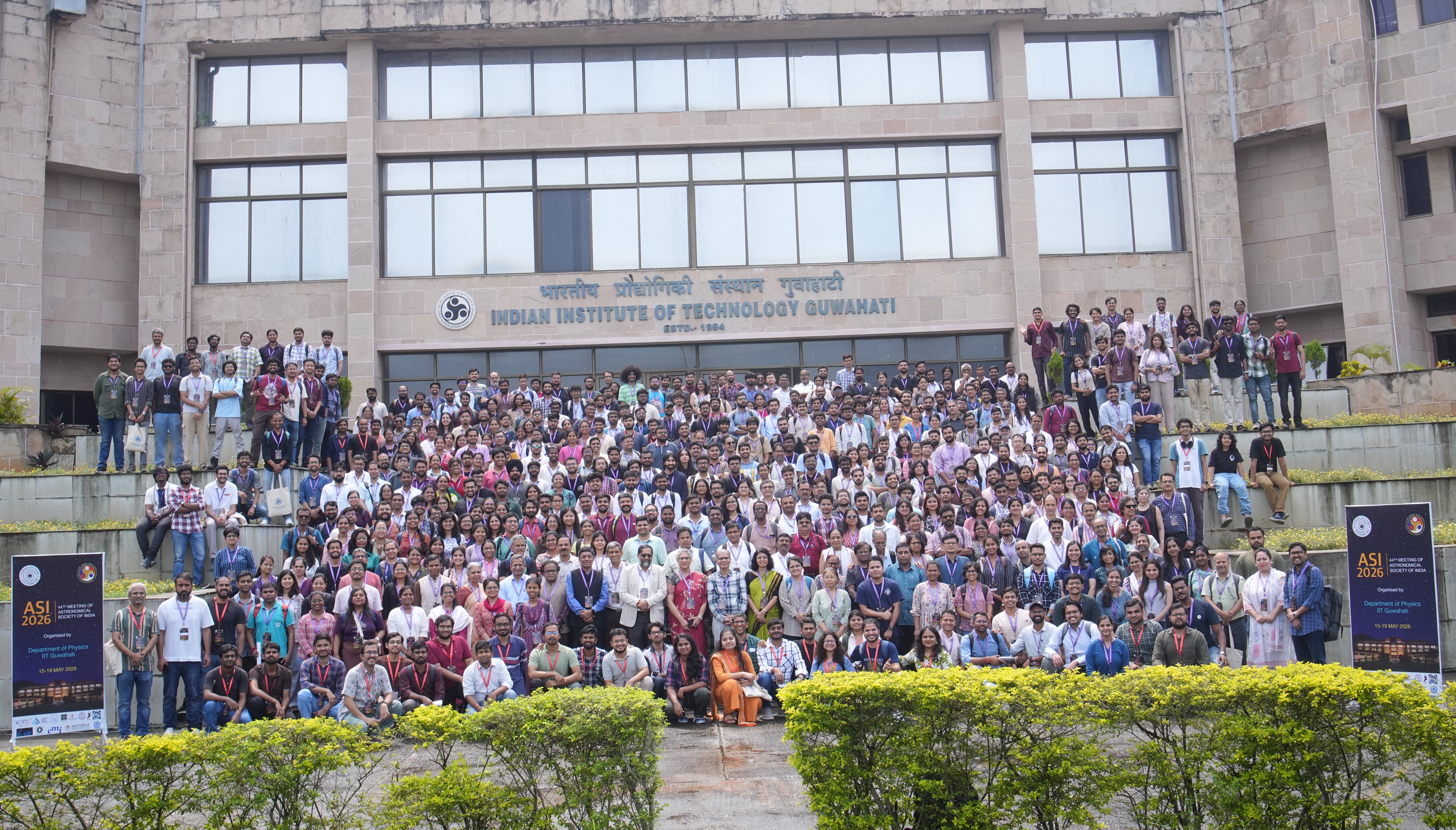
| Name: MITHUN PATRA |
| Affiliation: National Institute of Science Education and Research (NISER) |
| Conference ID: ASI2026_413 |
| Title: Reflected-Light Spectroscopy of Exoplanets with NEXOTRANS: New Pathways to Atmospheric Characterization |
| Abstract Type: Poster |
| Abstract Category: Sun, Solar System, Exoplanets, and Astrobiology |
| Author(s) and Co-Author(s) with Affiliation: Mithun Patra(National Institute of Science Education and Research, Bhubaneswar -752050, India), Swastik Dewan(National Institute of Science Education and Research , Bhubaneswar -752050, India), Liton Majumdar(National Institute of Science Education and Research , Bhubaneswar -752050, India) |
| Abstract: Future space-based direct-imaging missions, such as the Habitable Worlds Observatory (HWO), will enable high-contrast reflected-light spectroscopy of Earth-like terrestrial exoplanets orbiting Sun-like stars. We present NEXOTRANS, an in-house atmospheric forward and retrieval framework designed to characterize exoplanet atmospheres using reflected-light observations. The framework combines Bayesian inference, implemented with PyMultiNest, and a suite of machine-learning regression techniques, including Random Forest, Gradient Boosting, K-Nearest Neighbor, and Stacking Regressor, to efficiently constrain atmospheric compositions. Using physically self-consistent forward models, we quantify the information content of reflected-light spectra and assess the observational requirements for robust molecular detections across different classes of Earth-like planets. Specifically, we explore the dependence of atmospheric retrieval performance on wavelength coverage, spectral resolution, and signal-to-noise ratio relevant to HWO-class instrumentation. NEXOTRANS additionally incorporates wavelength-dependent surface reflectance, enabling the separation of atmospheric signatures from surface contributions in reflected-light spectra. Our results provide quantitative guidance on the observational parameter space required for detecting and characterizing molecular species in Earth analogs, and establish reflected-light spectroscopy as a key pathway for advancing comparative planetology and the search for habitable worlds with future direct-imaging missions. |