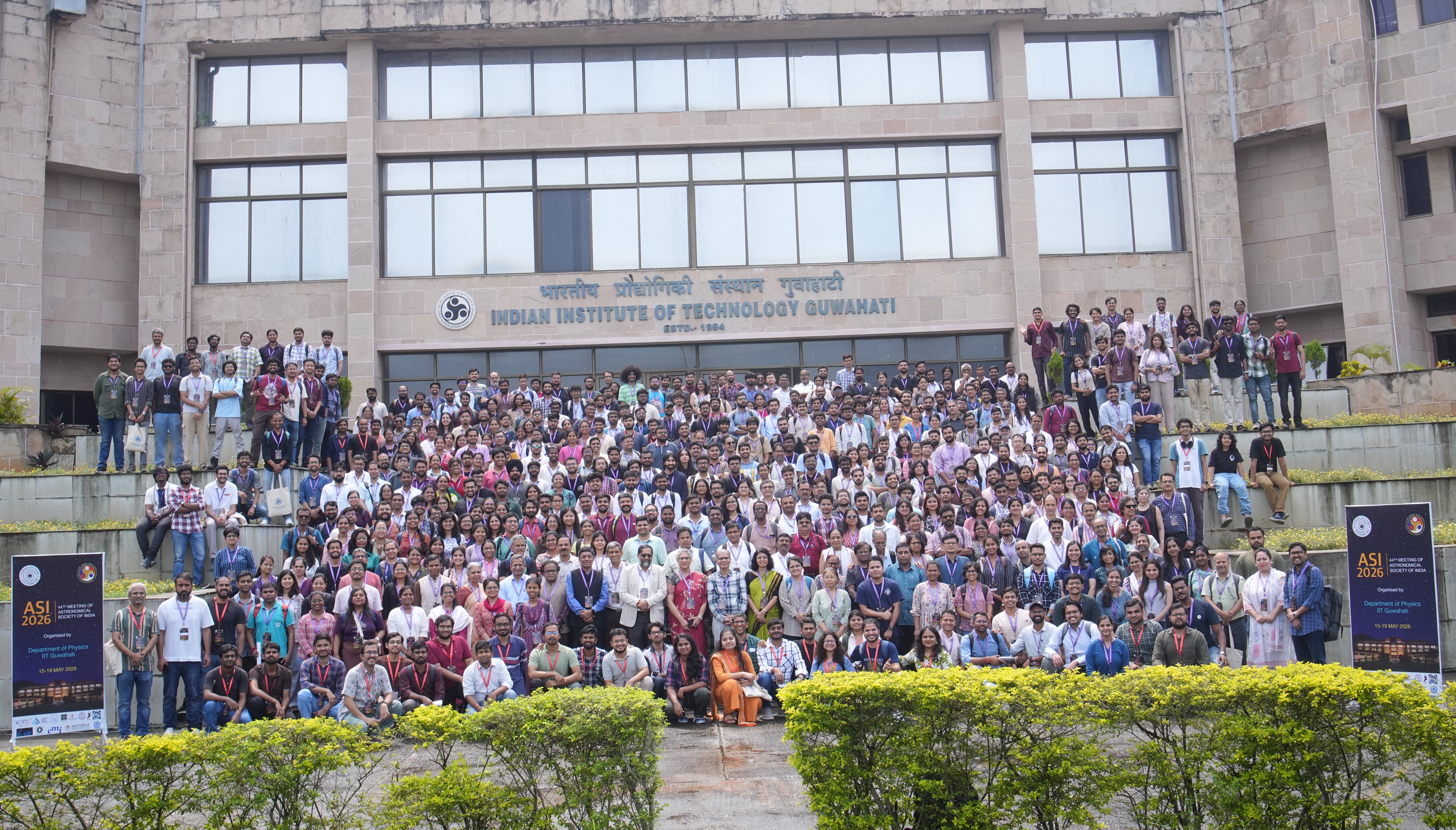
| Name: Priyanjali Patel |
| Affiliation: Universidad de Chile |
| Conference ID: ASI2026_365 |
| Title: Optical Variability in Quasars: A Wavelength-Dependent Study Using ZTF |
| Abstract Type: Oral |
| Abstract Category: Galaxies and Cosmology |
| Author(s) and Co-Author(s) with Affiliation: Priyanjali Patel(Universidad de Chile, Chile), Paulina Lira(Universidad de Chile, Chile), Patricia Arevalo(Universidad de Valparaíso, Chile), Mouyuan Sun(Xiamen University, Xiamen, China), Santiago Bernal(Universidad de Valparaíso, Chile), Mary Loli Martinez Aldama(Universidad de Concepción, Chile) |
| Abstract: Variability in quasars offers a powerful probe of the physical processes governing accretion
onto supermassive black holes. Understanding the wavelength dependence of this variability
is essential for testing and improving models of quasar variability.
We study optical g- and r-band light curves from the Zwicky Transient Facility Data Release
15 for a sample of approximately 5000 quasars. The sample is defined using the
homogeneous SDSS DR14 quasar catalog of Rakshit et al. (2020), providing
well-constrained black hole masses and Eddington ratios. A spectral model that accounts for
accretion-disk continuum emission, Balmer transitions, Fe II pseudo-continuum, and other
emission lines is used to reliably interpret the variance spectrum.
We quantify variability amplitudes by measuring the variance on different timescales using
the Mexican Hat filtering technique. Rest-frame wavelengths are probed through the redshift
distribution of the sample, with light curves corrected for redshift effects. By isolating
variability on timescales of 30, 75, 150, and 300 days, we find a strong anticorrelation
between median variance and rest-frame wavelength for quasars with black hole Mass
10^{8} M☉ and Eddington ratio of 10^{-1}. This behavior suggests that optical variability on
both short and long timescales originates from different annuli within the accretion disk. The
variance ratios also show a clear dependence on rest-frame wavelength.
The observed trends are consistent with a bending power-law power spectral density in which
both the characteristic damping timescale and the high-frequency slope vary with
wavelength. Comparison with the corona-heated accretion-disk reprocessing (CHAR) model
(Sun et al. 2020) shows good agreement, indicating that coronal-driven temperature
fluctuations play a key role in shaping the optical variability of quasars. This work is based
on the analysis presented in Patel et al. (2025). |