
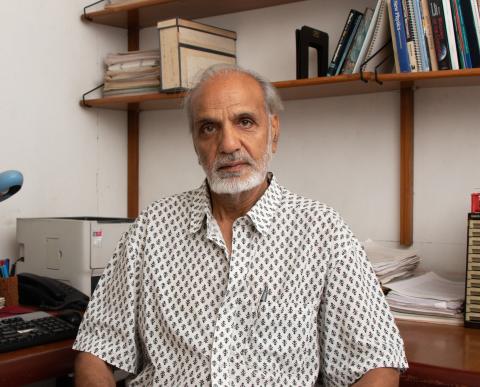
Professor Naresh Dadhich passed away, at the age of 81, on November 6, 2025 in Beijing while on an academic visit to China. His sudden demise is a tragic loss to the scientific community, and to the very large number of people from diverse fields and professions, in India and in many other countries, who were his friends, colleagues and collaborators. He worked mainly in general relativity and gravitation theory, and was one of the founders of the Inter-University Centre for Astronomy and Astrophysics (IUCAA), where he was Director during 2003-2009. He continued to be associated with the institute as an active scientist to the very end.
Dadhich was born and brought up in a village near Churu in Rajasthan, where his father was a priest. He left home for school at a young age, got his first degree in mathematics from BITS-Pilani and his M.Sc. from Vallabh Vidyanagar. He then reached the University of Poona (now SP Pune University, SPPU) in 1966, for research in mathematics. There he had the good fortune of becoming a Ph.D. student of the renowned mathematician and relativist Professor V. V. Narlikar, the father of Professor Jayant Narlikar. Naresh specialised in the very difficult area of general relativity, in which he became a great expert.
Soon after his Ph. D. in the early seventies, Naresh was appointed as a lecturer in the Department of Mathematics in SPPU, where his scientific journey truly began. He worked on classical and quantum aspects of gravity, with Lovelock Gravity being one of his favourites, brane world cosmologies, gravitational collapse, wormholes and the astrophysics of black holes. Over some years he gathered around him a number of highly talented young researchers, including Sanjeev Dhurandhar, B. S. Sathyaprakash and Patrick Dasgupta, who had obtained their Ph.D. from leading institutes in the country. There were also research students including Sanjay Wagh, Ravi Kulkarni, Sucheta Koshti and Varsha Daftardar. Some of these young people became internationally leading researchers in their areas. The work done during this period included the very interesting magnetic Penrose process for the extraction of energy from black holes. Naresh continued to publish until his last days, and had a paper accepted just a few days before he passed away. His essays for the Gravity Research Foundation annual competition got Honorable Mention several times, including in 2025, placing him amongst the oldest persons to be so honoured. He was President of the Indian Association of General Relativity and Gravitation many years ago.
Naresh had very simple sounding explanations for profound and difficult to understand concepts like the universality of space and time, constancy of the velocity of light, the curvature of space-time and its manifestation as gravity, derivations of Einstein’s field equations and so forth. He lectured on these matters to diverse audiences, ranging from professional scientists to students barely out of school, with the same words and elan. Over the last few months, I have heard him speak on these topics to early college students in Darjeeling and Masters and research students in Silchar. It was never clear to me how much of these lectures were actually understood by the young people listening to him, but they certainly enjoyed the experience of listening to a person who looked exactly like a scientist should, and spoke from his heart, wholly believing everything that he said.
Around 1987, Naresh’s life took a dramatic turn. Jayant Narlikar wanted to set up an inter-university centre for astronomy, which took form as IUCAA, and Naresh played a pivotal role in creating the place. He was the first person to be appointed on the rolls of IUCAA, even before Jayant Narlikar’s appointment as the Founding Director. Naresh worked tirelessly providing liaison between SPPU, UGC, the government of Maharashtra and several miniseries at the Centre. The very difficult task of setting up an institution with a complex structure was made so much easier because of his efforts. He helped in identifying and transferring a piece of land on the SPPU campus for the new institute.
The message that IUCAA had been created had to be taken far and wide in the country. Naresh and I travelled incessantly, sometimes accompanied by Jayant Narlikar and other colleagues, to the main cities, as well as to universities and colleges in the smaller cities and towns in far flung areas. We talked to the faculty and students there about the facilities that IUCAA offered. We convinced them that their own specialties in physics, mathematics and statistics could find wonderful applications in astronomy. Their expertise could be harnessed to solving new problems emerging from the multitude of new telescopes and satellites, and the use of emerging information technology. Soon the tide turned, and more and more people started visiting IUCAA regularly to collaborate with the people there. New groups of astronomers emerged in several universities and colleges, and now we have a thriving community contributing to the national astronomical effort. We were particularly successful in West Bengal, Assam, other North-Eastern states, Kashmir and Kerala, where there are a large number of talented young people looking for new opportunities. Naresh and I continued to travel to various centres until he left for China a few weeks ago. We did that together for 36 years, acquiring in the process many collaborators and friends. Our younger colleagues now continue the tradition, bringing to IUCAA increasing numbers of highly creative modern young people.
Naresh had deep and abiding friendships and collaborations with a number of relativists and astrophysicists in many countries. There was an unusual element to these collaborations. While he worked with leading scientists in Western countries, and visited them often, he also collaborated over decades with groups in various countries like Uzbekistan and other Central Asian republics, Iran, Turkey, Pakistan and South Africa. Faculty as well as students from these countries visited IUCAA regularly, and many Ph.D.s were produced through these interactions. His ties with South Africa began soon after apartheid ended and during his many visits to the country, he developed close ties with the intellectual elite there, including scientists from different fields, artists, constitutional court justices, senior science administrators, vice-chancellors and others, and he even had a meeting with Nelson Mandela soon after his release from prison.
Over the years, and especially when he was Director, Naresh helped in making large astronomical facilities available to IUCAA. He got the telescope at Girawali going, and he made IUCAA a partner in the Southern African Large Telescope. He also began the process of IUCAA and other institutions in the country becoming partners in the Thirty Meter Telescope project, and building a LIGO gravitational wave detector in India. Sanjeev Dhurandhar and Naresh tried to set up a gravitational wave detector in the country about 25 years ago, but they were far ahead of their time. Their pioneering efforts were not in vain, however, since they laid the foundation for the approval of the LIGO-India project in 2016.
Naresh had intellectual convictions which went far beyond his scientific side. In spite of his early family background, he was a non-believer and rationalist. He was a committed socialist and firmly believed in the equality of all men and women, young and old, and rich and poor. He was an activist and in spite of his busy schedule, often participated in marches and demonstrations on a variety of causes, including the environment. He lived a simple life bordering on the spartan, but he liked his fun too. He greatly enjoyed going to parties and organising many parties himself. Given the current rightwards march all over the world, I used to tell him that he would soon be the last jholawala still standing. He would of course have found a kindred spirit in the newly elected Mayor of New York, but he passed away before I could tell him that.
Naresh had a vast circle of friends and admirers in his home city of Pune and elsewhere in the country. He had very close ties with people from the performing arts and theatre all over. For many years, great playwrights, artists and thespians visited and performed in IUCAA, providing a rich and multihued background to the excellent science being done there.
Naresh is survived by his wife Sadhana, who is a deeply committed social worker and activist, his daughter Juee who is an entrepreneur in Information Technology, and his son Nishith, who is a successful producer of movies and serials.
Naresh clearly was a person of many parts. His tall, handsome, voluble presence, his infectious laughter and gracious company will be missed by many for long.
_______________
Ajit Kembhavi
IUCAA
-----------------------------------------------------------------------------------------------------------------
-----------------------------------------------------------------------------------------------------------------
Prof. Naresh Dadhich passed away on November 6, 2025, in Beijing, China. He was on an academic visit to the Beijing Institute of Mathematical Sciences and Applications (BIMSA). This news comes as a shock to all of us who have known him to be extremely active in both his academic and personal life. His passing is a great loss to the global GR community. At IUCAA, we have now lost two of our founders within a span of six months.
When we begin our research careers, we all hope for good health and a sustained passion for research until our last breath. In some sense, this wish was fulfilled for Naresh. Even at the age of 81, he was regularly coming to the institute and remained deeply engaged in research with the same enthusiasm as a newcomer. He was on an academic visit, delivering lectures, right up to his final moments.
I will always remember Naresh as a simple, caring, and approachable person—someone easy to meet, interact with, and always relaxed, positive, and supportive of good ideas. With this calm and unhurried approach, he managed to accomplish many things, despite not being the most organised person.
Naresh became the Director of IUCAA on July 19, 2003, after the retirement of Prof. Narlikar. It was indeed a big responsibility to take on. In his retirement address, Prof. Narlikar mentioned two major challenges that he had been unable to resolve during his tenure. In his very first staff meeting, Naresh said that he would consider his tenure successful only if he could address these two issues. All of us involved knew how difficult they were. Yet, through his persistent efforts, he managed to resolve both challenges satisfactorily within the first three years of his tenure.
This was possible because he never hesitated to take risks and was willing to meet people from all walks—within India and abroad—to get things done. Under his leadership, IUCAA became part of the SALT consortium and acquired observing shares, thanks largely to his contacts, guidance, and sustained support. To this day, it remains the only astronomy project in which an Indian institute holds observing shares in a telescope operated by an international collaboration.
He was deeply committed to making IUCAA a place where science is discussed openly and freely. During his tenure, he started the “Neem Seminar,” an informal chalk-and-board seminar held under the Neem tree near the guest house reception. Overall, his tenure as Director was one of the most productive periods for IUCAA.
He often used to say that being the Director of IUCAA is very easy—you just need to delegate responsibilities and support people so that they can deliver what they are supposed to do. I fully agree with him on this.
We had very little overlap in our research interests. However, he was always enthusiastic about our projects related to the variation of fundamental constants. During a particularly difficult period for me and my students—when other groups were challenging our work in various international conferences—he was extremely supportive and genuinely curious to understand the bottom line. We often had long discussions on this topic, as well as on issues related to compact stars and black holes.
He frequently came up with out-of-the-box (or perhaps even “crazy”) ideas and would ask whether there was any way to test them observationally. In this sense, he belonged to a rare class of scientists who engage in research for the sheer joy of exploration and are willing to consider all possibilities. Such people are becoming increasingly rare these days.
Having started his career in the university system, he was very keen that IUCAA members remain closely engaged with universities. He even suggested that all faculty should spend at least two weeks every year working in a university. To support this, he proposed that IUCAA could also support their partners if they accompanied them (something that would be nearly impossible to implement today!). He had built strong personal rapport with IUCAA Associates and their students across the country.
Until recently, he continued visiting various universities and colleges to deliver lectures and teach courses. He also maintained very strong ties with researchers in South Africa. In many ways, his personal contacts enabled IUCAA members to be part of major international surveys such as the “MeerKAT Absorption Line Survey (MALS)”, “Looking At the Distant Universe with the MeerKAT Array (LADUMA)”, and the “Hydrogen Intensity and Real-time Analysis eXperiment (HIRAX)”.
Naresh was extremely kind to his colleagues. I personally benefited from his generosity during certain moments when I needed help, as well as during our trips abroad together. While I am not sharing those details here, I will always cherish those memories.
We at IUCAA—and I personally—will miss his guidance and support during this crucial period.
_______________
R. Srianand
IUCAA